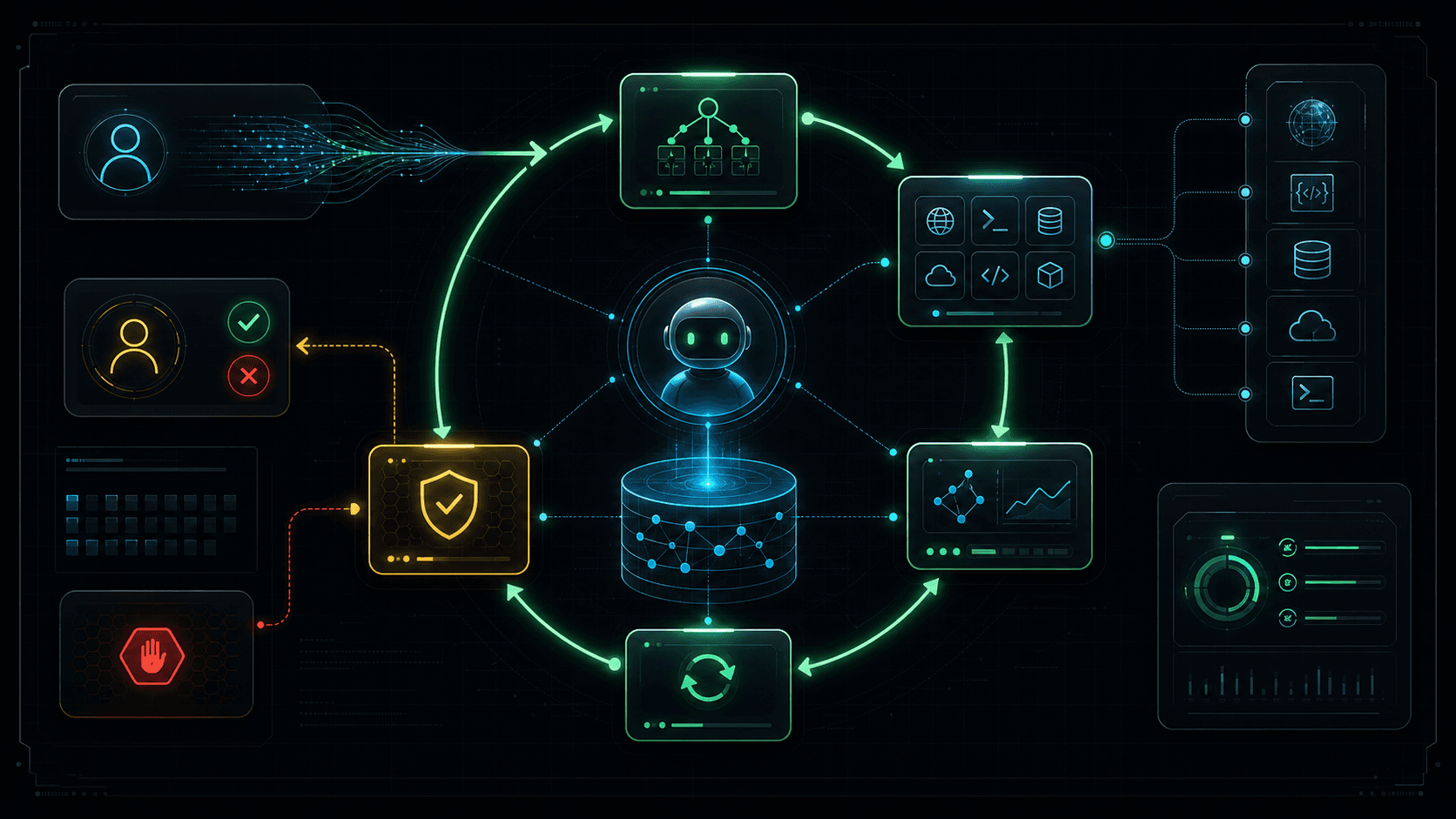
Autonomous agents are not just chatbots with longer prompts. They are systems that can interpret a goal, plan steps, use tools, observe results, revise their plan, follow policies, ask for approval, and produce an outcome.
The simplest way to understand them is as a runtime loop:
intent -> plan -> act -> observe -> replan -> govern -> complete
That loop is the heart of agentic AI. The model is important, but the system around the model is what turns a response generator into an execution engine.
1. Intent: The User Asks For An Outcome
An agent starts with intent. The user does not usually provide exact instructions. They provide a desired outcome.
Example:
Review the repo, fix the login redirect issue, run the checks, and prepare a summary.That request contains several implied tasks:
- inspect the codebase
- understand the auth flow
- find the likely bug
- edit files
- run validation
- summarize what changed
A simple chatbot might answer with advice. An autonomous agent tries to move the task toward completion.
2. Interpretation: The Agent Defines The Job
Before planning, the agent has to interpret what the user meant. This step is where many failures begin, so production systems should make it explicit.
{
  "intent": {
    "raw": "Review the repo, fix the login redirect issue, run the checks, and prepare a summary.",
    "classified": "CODE_CHANGE",
    "success_criteria": [
      "Bug is identified",
      "Minimal code change is applied",
      "Validation checks are run",
      "Summary is provided"
    ],
    "risk": "medium"
  }
}
The agent is not only reading words. It is building a working contract for the task.
3. Planning: The Agent Chooses A Path
Once the task is interpreted, the agent creates a plan. A good plan is short, inspectable, and easy to revise.
{
  "plan": [
    {
      "id": "step_1",
      "goal": "Inspect authentication routes and providers"
    },
    {
      "id": "step_2",
      "goal": "Find redirect logic related to login callback"
    },
    {
      "id": "step_3",
      "goal": "Apply minimal fix"
    },
    {
      "id": "step_4",
      "goal": "Run lint and focused validation"
    },
    {
      "id": "step_5",
      "goal": "Summarize changes and residual risk"
    }
  ]
}
Planning does not mean the agent knows everything up front. It means the agent has a next best path and a way to check whether that path is working.
4. Tool Use: The Agent Acts On The World
Agents become useful when they can use tools. Tools can include:
- file search
- code editing
- terminal commands
- browser navigation
- databases
- APIs
- calendars
- design systems
- deployment systems
The tool layer is where an agent crosses from language into action.
{
  "tool_call": {
    "id": "tool_018",
    "name": "repo.search",
    "input": {
      "query": "redirect",
      "scope": "app components lib"
    },
    "parent_step_id": "step_2"
  }
}
Every tool call should point back to the plan step that caused it. Otherwise you can see what the agent did, but not why it did it.
5. Observation: The Agent Reads The Result
After acting, the agent observes the result. This can be a search result, file contents, a failing test, a browser screenshot, an API response, or a policy denial.
{
  "observation": {
    "tool_call_id": "tool_018",
    "result_type": "search_results",
    "summary": "Redirect logic appears in AuthProvider and callback route.",
    "next_signal": "inspect matched files"
  }
}
Observation is what makes agents iterative. They do not simply execute a fixed script. They look at what happened and decide what to do next.
6. Replanning: The Agent Adjusts
If the agent discovers that the first plan is wrong, it should revise the plan instead of pushing forward blindly.
{
  "replan": {
    "reason": "Initial search found redirect logic in a shared auth provider, not only the callback route.",
    "changes": [
      "Inspect AuthProvider before editing callback page",
      "Add validation around missing returnUrl"
    ]
  }
}
Replanning is not failure. It is the normal shape of autonomous work.
7. Governance: Policies Decide What Is Allowed
Autonomy without governance is just uncontrolled execution. Before an agent performs meaningful side effects, the system should evaluate policy.
{
  "policy_check": {
    "action": "file.write",
    "resource": "components/auth/AuthProvider.tsx",
    "decision": "requires_approval",
    "reason": "Auth-related file change"
  }
}
Policies can allow, deny, or escalate actions. The best policy systems are close to the tool layer, because every important side effect passes through tools.
8. Approval: Humans Stay In Control
Some actions should pause for human approval. The approval prompt should show the action, scope, risk, evidence, expiration, and rollback plan.
{
  "approval_request": {
    "action": "file.write",
    "resources": ["components/auth/AuthProvider.tsx"],
    "risk": "medium",
    "evidence": "diff_preview",
    "expires_in_seconds": 900,
    "rollback": "restore_snapshot"
  }
}
This is how a system can be autonomous without removing the human. The agent can keep moving through low-risk steps, but pause when the action crosses a meaningful boundary.
9. Memory And Context
Agents often need memory, but memory should be treated carefully. There are different kinds:
| Memory type | Example | Risk |
|---|---|---|
| Session memory | Current task plan and tool outputs | Low |
| Project memory | Repo conventions and architecture notes | Medium |
| User memory | Preferences and recurring instructions | Medium |
| Long-term operational memory | Prior approvals, incidents, credentials | High |
Memory should be scoped, inspectable, and forgettable. An agent that remembers everything forever becomes hard to trust.
10. Outcome: The Agent Closes The Loop
An autonomous run should end with a clear outcome event.
{
  "outcome": {
    "status": "completed",
    "summary": "Login redirect bug fixed with a minimal AuthProvider change.",
    "checks": [
      {
        "name": "lint",
        "status": "passed"
      }
    ],
    "matched_intent": true,
    "residual_risk": "No full end-to-end login test was run."
  }
}
The outcome should connect back to the original intent. Did the agent actually do what the user asked? What changed? What was verified? What remains uncertain?
The Full Runtime Loop
Put together, the agent loop looks like this:
User Intent
  -> Interpret Goal
  -> Create Plan
  -> Use Tool
  -> Observe Result
  -> Replan If Needed
  -> Evaluate Policy
  -> Ask For Approval When Needed
  -> Execute Side Effect
  -> Record Outcome
In small demos, this loop can fit inside a few functions. In production systems, each part becomes its own layer: planner, tool gateway, policy engine, approval service, memory store, trace collector, and user interface.
Where This Site Covers The Pieces
This site already breaks the runtime into deeper parts:
- The Agent Loop explains the recursive planning and execution heartbeat.
- Agent Skills explains how agents discover and use modular capabilities.
- The Architecture of Autonomy explains guardrails and contextual governance.
- Securing the Agentic Workspace explains filesystem safety and sandbox handshakes.
- The Agent Observability Stack explains traces, tool logs, policy events, and outcomes.
- Designing Approval UX for Autonomous Agents explains human control surfaces.
- WebMCP explains how browser runtimes can expose tools and context.
- A2UI Part 3 explains generated UI event security.
This article is the map. The rest of the series are the components.
Conclusion
Autonomous agents work because they combine reasoning with execution. The model helps interpret intent and choose the next step, but the runtime makes the work reliable: tools, observations, policies, approvals, memory, and traces.
The future of agentic AI will not be defined only by smarter models. It will be defined by better systems around those models: systems that can act, explain, pause, recover, and leave a clear record of what happened.
Related Research
The Agent Loop: Engineering the Cognitive Heartbeat
Beyond one-shot prompts. Designing recursive loops that handle planning, execution, and self-correction without drifting into infinite recursion.
Agentic AIThe Agent Observability Stack: Tracing Intent, Tools, Policy, and Outcomes
Agents become trustworthy when every intent, plan, tool call, policy decision, approval, and outcome can be inspected as one coherent trace.
Agentic AIDesigning Approval UX for Autonomous Agents
Autonomous agents need approval surfaces that explain risk, scope, expiration, evidence, and rollback before a human grants permission.
Agentic AIThe Architecture of Autonomy: Building Guardrails for Agentic Systems
Moving from Passive AI (chat) to Active Agents (execution). A shift from simple RBAC to Contextual Governance.